PivotolAI BMS layers edge computing and AI optimisation on top of your building infrastructure — turning raw sensor data into autonomous energy savings without replacing what you already have.
Most building management systems were designed to monitor — not to optimise. The result: wasted energy, reactive maintenance, and compliance headaches that drain budgets and resources.
Legacy BMS systems collect data but do nothing with it. Operators stare at dashboards without actionable insight — problems are found after they've already cost money.
Equipment failures are discovered when something breaks. Unplanned downtime disrupts operations, inflates repair costs, and puts compliance at risk.
Fixed schedules and static setpoints mean HVAC, boilers, and CHP run at sub-optimal levels — burning energy and budget 24/7, regardless of actual demand.
Energy compliance reports are assembled manually before every audit. Data gaps, missing timestamps, and inconsistent formatting turn regulation into a recurring crisis.
HVAC, lighting, metering, and fire systems all run on separate controllers with no unified view — making cross-system optimisation impossible.
Full BMS replacements require months of commissioning, significant capital expenditure, and prolonged operational disruption — so nothing changes.
PivotolAI BMS is an intelligent building management layer that sits on top of your existing infrastructure. It connects to any BMS, any sensor array, or any plant room — and transforms passive monitoring into autonomous energy optimisation.
Data is processed at the edge in real time — not batched to the cloud. AI models continuously learn your building's operating patterns, detect anomalies before they become failures, and actively adjust setpoints to minimise energy consumption while maintaining comfort and compliance.
The result: a building that manages itself — reducing costs, eliminating reactive maintenance, and generating compliance reports automatically.
Data processed locally in milliseconds. No cloud latency. No bandwidth bottleneck.
Machine learning models adapt to your building's unique patterns and predict failures.
Autonomous setpoint control drives continuous energy savings within safe bounds.
Five stages take your building from passive monitoring to intelligent, self-optimising operation — all without disrupting live systems.
Sensors, meters, and existing BMS connections feed real-time data from HVAC, boilers, CHP, and electrical systems into the PivotolAI platform.
Data is ingested and processed at the edge — locally, in milliseconds. No cloud round-trips. Immediate signal conditioning, filtering, and anomaly flagging.
AI engines build a digital model of your building's operating envelope — learning normal behaviour, seasonal patterns, and equipment baselines over time.
Machine learning continuously adjusts setpoints, schedules, and control logic — driving energy consumption to the minimum while maintaining comfort and compliance.
Dashboards surface real-time insights, compliance reports generate automatically, and alerts notify operators only when human action is genuinely required.
Everything you need to monitor, control, optimise, and integrate your building — grouped by capability.
Real-time equipment dashboards showing current state, performance metrics, and health indicators for every connected asset.
ML-driven monitoring surfaces deviations from normal operating patterns — flagging faults before they escalate into failures.
Historical trend analysis and forecasting across all building systems — identify patterns, benchmark performance, and track improvement.
Configurable threshold and anomaly notifications. Operators are alerted only when human intervention is genuinely required.
Autonomous setpoint control within defined operating envelopes — continuously driving energy consumption to the safe minimum.
Custom automation sequences, scheduling, and conditional control logic — built to match your operational requirements exactly.
Full site monitoring and control from any device. Manage your building remotely with the same depth as the main dashboard.
Define and enforce safe operating bounds for every asset. The system prevents operation outside proven safe limits.
Machine learning insights on consumption patterns, equipment degradation, and optimisation opportunities across your entire estate.
Automated, regulatory-ready energy compliance reports — generated, timestamped, and available on demand without manual assembly.
Financial impact modelling that quantifies what doing nothing is costing you — making the business case for optimisation self-evident.
Granular consumption tracking per asset, per zone, per time period — giving complete visibility into where energy is being used and wasted.
Wireless sensors and pre-configured gateway. Zero wiring, operational in 72 hours — the fastest path to AI building intelligence.
Connects directly to your current BMS — BACnet, Modbus, OPC-UA, and proprietary protocols. No hardware replacement required.
Full BMS replacement with new WAGO controllers, fully integrated with PivotolAI from day one for maximum control depth.
RESTful API for integration with third-party platforms, energy management systems, and enterprise software suites.
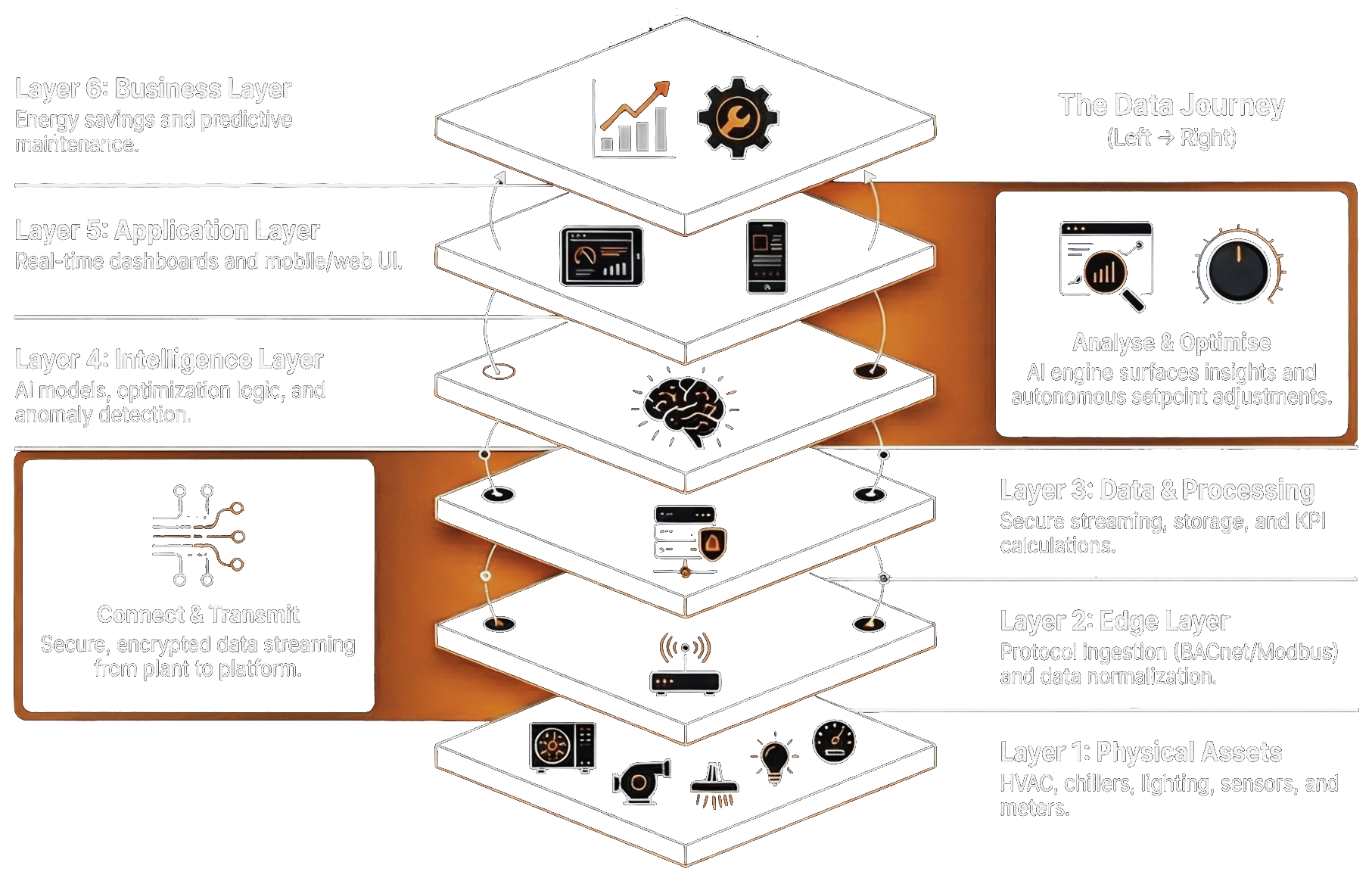
A simplified view of how PivotolAI BMS is structured — from the physical plant to the intelligence layer that drives autonomous optimisation.
Sensors, meters, actuators, and controllers on the building plant — HVAC, boilers, CHP, lighting, and electrical systems.
On-premise edge gateways ingest, condition, and process data locally — enabling sub-second response times without cloud dependency.
AI/ML models run at the edge and in the cloud — continuously learning operating patterns, detecting anomalies, and generating optimisation commands.
Dashboards, mobile apps, compliance reporting, and API integrations — the interface layer for operators, managers, and automated systems.
AI-driven setpoint optimisation consistently closes the gap between how your building runs and how it should run — measurable in kWh and cost.
Automated compliance reporting, predictive maintenance scheduling, and AI analysis eliminate hours of manual work every week.
Predictive fault detection catches equipment degradation before failure — eliminating unplanned downtime and costly emergency repairs.
Start with a single plant room and scale to an entire estate. The same platform, the same models, the same intelligence — just more connected assets.
PivotolAI BMS isn't another monitoring dashboard. It's an optimisation engine — built from the ground up to actively reduce energy, not just report on it.
Processing happens at the edge — not in a remote data centre. Sub-second response times, no internet dependency for critical control loops, and full operation during connectivity outages.
Most BMS platforms stop at monitoring. PivotolAI starts with optimisation — AI-driven setpoint control is not an add-on, it's the core architecture. Every feature is built to reduce consumption.
Start with wireless sensors and a suitcase package. Scale to BMS integration. Upgrade to full WAGO control. Each step adds capability without replacing what came before.
BACnet, Modbus, OPC-UA, proprietary — PivotolAI connects to any building protocol. No vendor lock-in, no rip-and-replace, no stranded assets.
All optimisation operates within defined operating envelopes. The system will never push equipment beyond proven safe limits — autonomous, but always within bounds.
The Suitcase Package deploys in 72 hours. BMS integration takes days. Even full WAGO upgrades are faster than traditional commissioning — minimal disruption, maximum speed.
From single commercial buildings to multi-site industrial estates — PivotolAI BMS adapts to the complexity and scale of your operation.
Offices, retail centres, and mixed-use developments where HVAC and lighting are the dominant energy consumers.
Manufacturing plants, warehouses, and processing facilities with complex mechanical systems and high energy demands.
Multi-site estates and portfolio-level energy management where visibility, benchmarking, and cost reduction are strategic priorities.
Our engineers will assess your infrastructure, map your energy profile, and recommend the right deployment pathway — at no cost and no commitment.